
Information Model for SMART content
An open, shared language for data interoperability. By the world's largest developers of standards.
It's a digital world. International standards need to be easy to access, combine and use across markets, systems, and workflows.
The IEC & ISO Information Model for SMART defines the core concepts, relationships, and attributes that ensure standards content is Findable, Accessible, Interoperable, and Reusable (FAIR).
Use
Freely available via Open Source license
Our Information Model is shared under an open license (CC BY-SA 4.0) which everyone can use.
It provides the standardization community with an open, shared and extensible language required for data interoperability, which helps standards users and organizations save time and money. For example, this means users can access Requirements directly, reducing errors and improving confidence in how standards are applied.
Release
Version 2.1.0-0.1.0 - September 2026 (pre-release)
Adding new features and enhancements, implementing improvements and bug fixes.
Version 2.0.0 - May 2026
This version establishes a solid foundation for quality, security, and fitness for purpose, and supports the extraction of provisions from standards.
.png)
Engage
Submit feedback
The IEC & ISO Information Model for SMART content will continue to expand and mature over time. Your input helps shape future releases, so share your feedback via this form. We want to hear from you.
Identify an issue
Something wrong? Inform us of a bug or problem with the current version of the Information Model at this form.
Understand
Why do we need an Information Model?
Standards users often work with multiple standards from various sources, each with their own formats and structure. Without a common framework, reconciling these differences becomes costly.
The Information Model provides the standardization community with an open, shared and extensible language that enables data interoperability, saving standards users time and money.
Released by the SMART Single Delivery Unit (SDU) – a joint taskforce for IEC and ISO's shared approach to evolving international standards so they are easier to access, combine and apply in a digital world; with the authority, rigor and trust that users depend on.
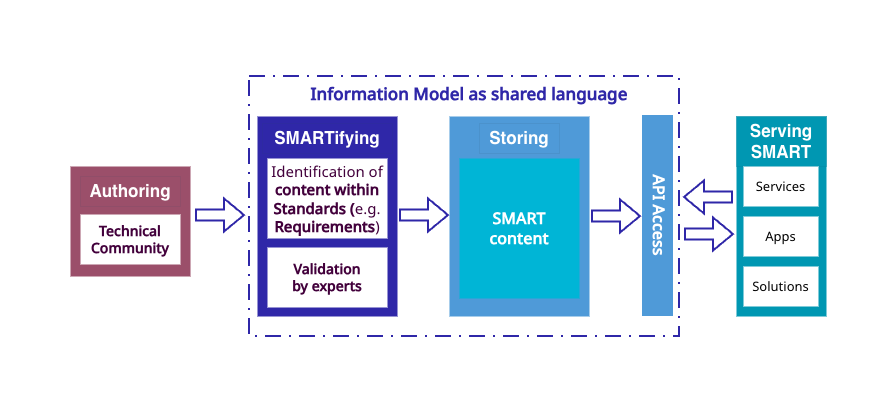
What is the Information Model for SMART content?
The IEC & ISO Information Model defines the core concepts, relationships, and attributes that ensure standards content is Findable, Accessible, Interoperable, and Reusable (FAIR).
For example, this means users can access Requirements directly, reducing errors and improving confidence in how standards are applied.
Educational Resources
Information Model panel – 2nd Annual SMART Conference session
FAQs
What is the Information Model made of?
Ontologies defining standardization concepts, their relationships, their attributes.
Find the documentation
How can I contribute?
You can provide feedback
Will it change?
The Information Model will evolve as new use cases arise so the Information Model stays fit for purpose and high quality.
What comes next?
Information Model Roadmap
Q2 2026
Ad-hoc IMv2 minor releases
Q3 2026
tbc
Q4 2026
tbc
Q4 2026
tbc
Q1 2027
tbc
Q2 2026
ad-hoc IMv2 minor releases
Q2 2026
tbc
Q3 2026
tbc
Q4 2026
tbc
Q1 2027
tbc
Can I use an Information Model to create SMART content?
The Information Model defines what SMART content looks like, but on its own it’s not enough. You need a tool to extract SMART content from a standard and describe it according to the model.
Does it support non-English languages?
The Information Model is a descriptive document in English. You can evolve/expand it to support other languages.
